


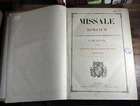

A Roman Missal Dated 1868 By H. Dessain, Acquired From A Monastery
$ 222.74
Description
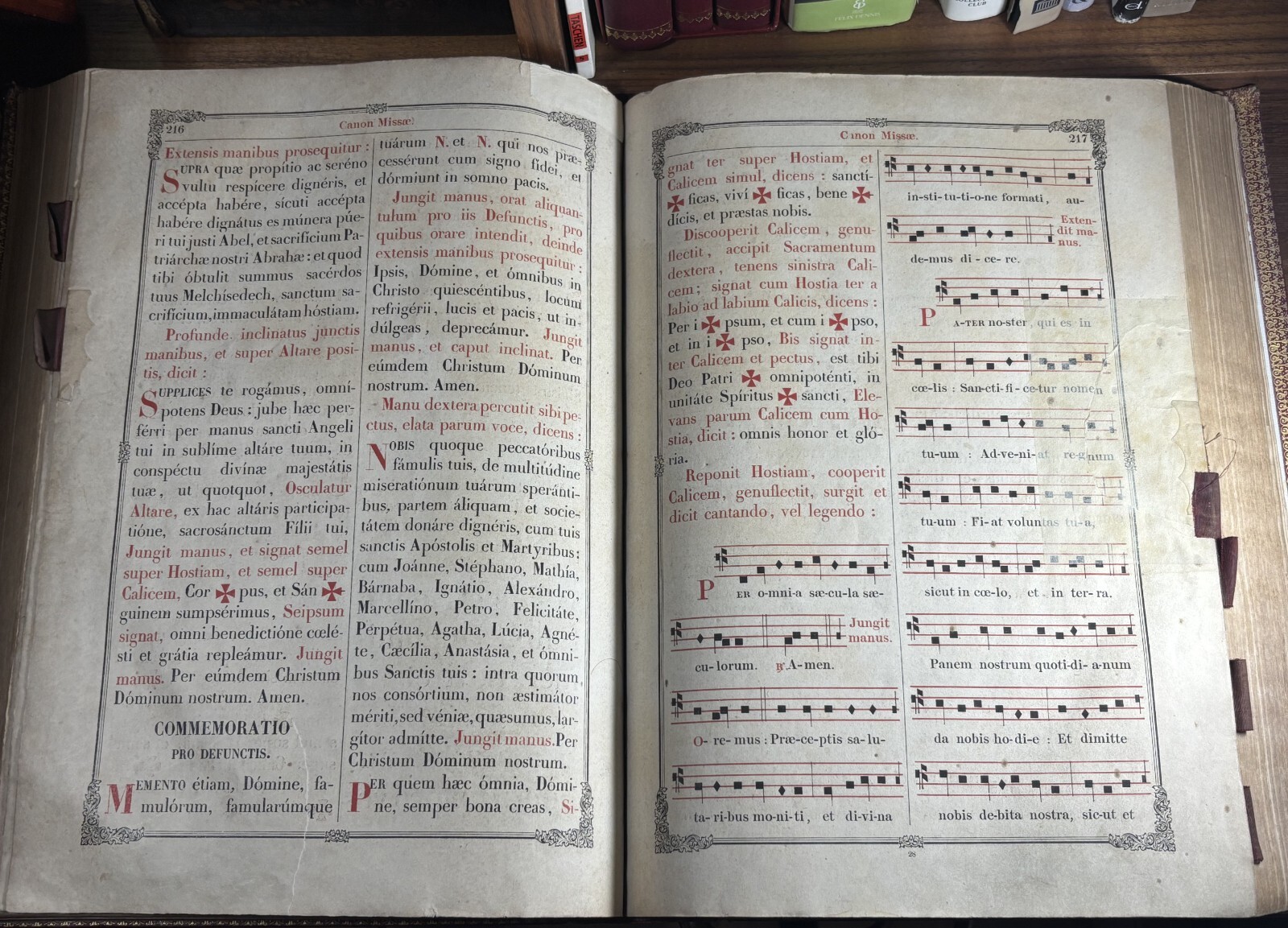
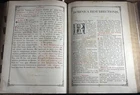
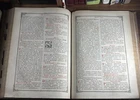
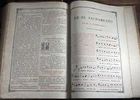
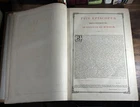
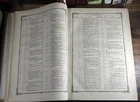
A Belgian Roman Missal Dated 1868: Beautiful Roman missal from a monastery, bound in rich red Morocco leather decorated with gilded lace borders on the covers, featuring a large gilded liturgical shield at the centre. The spine is ornately tooled, with gilded edges and fabric end leaves. Printed in two inks on two columns, the missal uses a typography suited to the rites and Gregorian notation for plainchant scores. Thus, this Missale Romanum published by H. Dessain, successor of P.J. Hanicq, in Mechelen (Malines) in 1868, is part of the long tradition of post-Tridentine Roman Missals. This particular edition was published nearly three centuries after the Tridentine Missal promulgated by Pope Pius V in 1570 following the Council of Trent. The Dessain printing house, which produced this Missal, had a rich history dating back to 1680, initially established in Reims before moving to Liège between 1740 and 1854, and then settling permanently in Malines. Specialized initially in religious works, this family publishing house was the official printer for the prince-bishop of Liège, which gave its liturgical publications a certain authority during a period when the Catholic Church, under the papacy of Pius IX (1846-1878), strongly asserted its tradition in the face of modernist currents, emphasizing the importance of official liturgical texts as guarantors of the unity and orthodoxy of the faith. The final part of the Roman Missal by Dessain and Hanicq contains a rich collection of prayers and blessings suited to various circumstances of ecclesiastical and daily life. These liturgical formulas, inherited from the medieval tradition, include not only the usual blessings of sacred objects (chalices, patens, sacerdotal ornaments) and sacramentals (water, salt, candles), but also more specific rites reflecting the concerns of the time. Among other things, there are blessings to protect crops against bad weather, prayers for travellers undertaking long journeys, special prayers against epidemics that regularly afflicted populations, as well as ritual formulas for blessing ships or performing exorcisms. Some more unusual blessings demonstrate how Catholic liturgy sought to envelop all aspects of the faithful's daily life with spiritual protection, in a world where science and faith were still closely intertwined. Like many church missals, this one has the flaws of a centuries-old use: rubbed binding, sun-dried spine, missing moiré guard, repairs on many pages, a lack of paper on the engraved plate, several pages missing at the end and others added to match the part of the masses and special prayers with the customs of the monastery, stamps of a religious institution on the title page, several other minor flaws. The Roman Missal (Missale Romanum) is a fundamental element in the celebration of Catholic worship within churches and monasteries. This essential liturgical book gathers all the necessary texts for the celebration of the Mass according to the Roman rite: the ordinary of the Mass, chants, readings, prayers, and various ritual and musical instructions. Before the early Middle Ages, several separate books were used during services: the sacramentary containing the Eucharistic prayer, prayers and petitions; the lectionary and epistolary for biblical readings; as well as specific books for responses and chants such as the gradual or antiphonary. Gradually, these elements were integrated into a single volume called the "whole missal" (missale plenum), allowing celebrants to have all liturgical texts in one volume, thus facilitating the celebration and ensuring uniformity of ritual practices throughout the Catholic Church. Dimensions: Weight - 3.42KG Height - 36.5cm Width - 26cm Thickness - 5cm Damage (Please see above photos for reference): There is some scratches on the front and back covers. The spine has slight cracking. The book is slightly "slanted". There is tape on one of the pages.
Item arrived much better than described and is such a privilege to own, ty as this probably cost you more to send than I paid (honestly, I expected the item to be of much, much poorer quality for the prise!), well packaged and shipped fast. would encourage anyone to buy from this person! A +++
I pressed wrong knob and declined your 1st offer by mistake , so thanks for agreeing same price , it was very decent of you . Kind regards and thanks , waiting for it to be delivered Tomorrow Ann
Beautiful! A piece of history in great condition for being 250 years old. Fast shipping with tracking was very helpful. Very pleased with kind and fast service.
Related products
1888 Historical Memoirs of the West by W.H. Hamilton Rodgers
$ 21.12Easton Press Odyssey Of Homer Genuine Leather Bound Gold Gilt
$ 25.35Hawaii by James Michener Vol 1 & 2 Easton Press 1988 Limited Edition Leatherbound Set
$ 63.36Complete Leatherbound Jane Austen Collection – Pride and Prejudice, Emma & More
$ 19.94