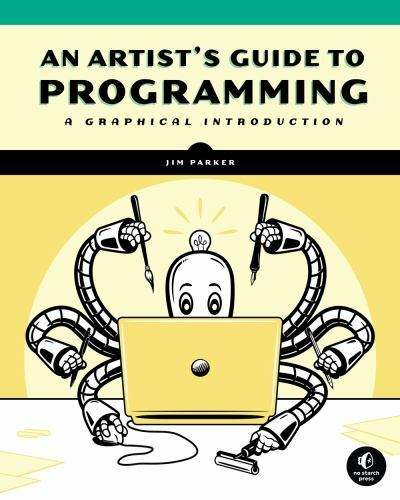
Artist's Guide to Programming: A Graphical Introduction by Jim Parker 2022 Trade Paperback
$ 6.01
gtin13:
9781718501645
Item Height:
0.8 in
brand:
No Starch Press, Incorporated
TitleLeading:
An
ISBN-13:
9781718501645
ISBN-10:
1718501641
Dewey Decimal:
006.7
Publication Year:
2022
Author:
Jim Parker
Item Length:
10 in
LCCN:
2021-046087
Intended Audience:
Trade
Subject Area:
Mathematics, Computers
Item Weight:
19.5 Oz
Language:
English
Dewey Edition:
23
Type:
Textbook
Publisher:
No Starch Press, Incorporated
Subject:
Programming / Games, Computer Graphics, Programming / Open Source, General
Number of Pages:
248 Pages
Illustrated:
Yes
Synopsis:
Learn to program with visual examples. Programs increase in complexity as you progress -- from drawing a circle to 3D graphics, animations, and simulations. A Graphical Introduction to Programming teaches computer programming with the aid of 100 example programs, each of which integrates graphical or sound output. The Processing-language-based examples range from drawing a circle and animating bouncing balls to 3D graphics, audio visualization, and interactive games. Readers learn core programming concepts like conditions, loops, arrays, strings and functions, as well as how to use Processing to draw lines, shapes, and 3D objects. They'll learn key computer graphics concepts like manipulating images, animating text, mapping textures onto objects, and working with video. Advanced examples include sound effects and audio visualization, network communication, 3D geometry and animation, simulations of snow and smoke, predator-prey populations, and interactive games., Today's artists need to know how to work with pixels as well as with pencils. An Artist's Guide to Programming provides a creative introduction to coding using Processing, a Java-based language designed to be visually intuitive. In 100 short, hands-on lessons, you'll go from drawing lines and circles to creating sophisticated simulations and interactive games. No previous programming experience is required. Each lesson features a one-page Processing program, or sketch, that produces graphical or sonic output. Alongside the program, you'll find a detailed explanation of the code, the concepts behind it, and images of the result. You'll be amazed at what you can do with your short, experimental programs, from creating a driving simulation to drawing intricately realistic plants to generating audio visualizations and more. You'll learn how to: Draw basic shapes, set colors, add textures, and animate text, Work with or manipulate image, video, and sound files, Create user interfaces and generate interactive multidimensional animations, Simulate real-world phenomena, like smoke, flocking birds, and the Northern Lights, Share your work online, Beyond artistic techniques, you'll also build up a foundational knowledge of computer science. You'll learn how to use variables, loops, conditions, functions, and classes to write your own programs and bring your ideas to life through code. By the end of the book, you'll be able to make your own digital artwork or apply your programming prowess to other creative disciplines. Book jacket., Learn to program with visual examples. Programs increase in complexity as you progress - from drawing a circle to 3D graphics, animations, and simulations. A Graphical Introduction to Programming teaches computer programming with the aid of 100 example programs, each of which integrates graphical or sound output. The Processing-language-based examples range from drawing a circle and animating bouncing balls to 3D graphics, audio visualization, and interactive games. Readers learn core programming concepts like conditions, loops, arrays, strings and functions, as well as how to use Processing to draw lines, shapes, and 3D objects. They'll learn key computer graphics concepts like manipulating images, animating text, mapping textures onto objects, and working with video. Advanced examples include sound effects and audio visualization, network communication, 3D geometry and animation, simulations of snow and smoke, predator-prey populations, and interactive games.
Format:
Trade Paperback
LC Classification Number:
QA76.575.P357 2022
Publication Name:
Artist's Guide to Programming : a Graphical Introduction
Item Width:
8 in
This book is a fantastic resource for artists diving into coding! Jim Parker breaks down complex programming concepts with clear, visual examples, making it easy to grasp. The hands-on approach helps bridge creativity and tech seamlessly. Perfect for beginners or anyone wanting to blend art with code—highly recommend!