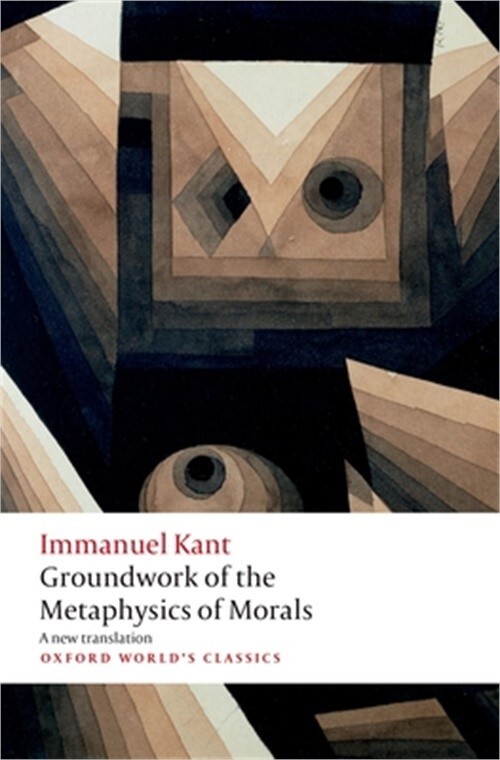

Kant's Groundwork for the Metaphysics of Morals - 2020 Trade Paperback by Saunders and Bennett

$ 5.26

Table Of Content: Introduction Note on the translation and the text Select bibliography A chronology of Immanuel Kant Groundwork for the Metaphysics of Morals 1: Transition from common to philosophical rational knowledge of morality 2: Transition from popular moral philosophy to the metaphysics of morals 3: Transition from the metaphysics of morals to the critique of pure practical reason Explanatory notes Glossary Index Item Height: 0.3 in brand: Oxford University Press, Incorporated LC Classification Number: MLCS 2022/40864 (B) Book Series: Oxford World's Classics Ser. Language: English Dewey Decimal: 170 Topic: Ethics & Moral Philosophy, General Intended Audience: Trade LCCN: 2019-948775 Genre: Philosophy Item Width: 5 in Format: Trade Paperback Book Title: Groundwork for the Metaphysics of Morals ISBN-10: 0198786190 Author: Joe Saunders, Immanuel Kant, Christopher Bennett Item Weight: 5.6 Oz Number of Pages: 176 Pages Dewey Edition: 21 ISBN-13: 9780198786191 Item Length: 7.7 in Publisher: Oxford University Press, Incorporated Synopsis: [T]he present groundwork is nothing more than the identification and vindication of the supreme principle of morality.' In the Groundwork for the Metaphysics of Morals (1785), Immanuel Kant makes clear his two central intentions: first, to uncover the principle that underpins morality, and secondly to defend its applicability to human beings. The result is one of the most significant texts in the history of ethics, and a masterpiece of Enlightenment thinking. Kant argues that moral law tells us to act only in ways that others could also act, thereby treating them as ends in themselves and not merely as means. Kant contends that despite apparent threats to our freedom from science, and to ethics from our self-interest, we can nonetheless take ourselves to be free rational agents, who as such have a motivation to act on this moral law, and thus the ability to act as moral beings. One of the most studied works of moral philosophy, this new translation by Robert Stern, Joe Saunders, and Christopher Bennett illuminates this famous text for modern readers., T]he present groundwork is nothing more than the identification and vindication of the supreme principle of morality.' In the Groundwork for the Metaphysics of Morals (1785), Immanuel Kant makes clear his two central intentions: first, to uncover the principle that underpins morality, and secondly to defend its applicability to human beings. The result is one of the most significant texts in the history of ethics, and a masterpiece of Enlightenment thinking. Kant argues that moral law tells us to act only in ways that others could also act, thereby treating them as ends in themselves and not merely as means. Kant contends that despite apparent threats to our freedom from science, and to ethics from our self-interest, we can nonetheless take ourselves to be free rational agents, who as such have a motivation to act on this moral law, and thus the ability to act as moral beings. One of the most studied works of moral philosophy, this new translation by Robert Stern, Joe Saunders, and Christopher Bennett illuminates this famous text for modern readers., 'The present groundwork is nothing more than the identification and vindication of the supreme principle of morality.'In the Groundwork for the Metaphysics of Morals (1785), Immanuel Kant makes clear his two central intentions: first, to uncover the principle that underpins morality, and secondly to defend its applicability to human beings. The result is one of the most significant texts in the history of ethics, and a masterpiece of Enlightenment thinking. Kant argues that moral law tells us to act only in ways that others could also act, thereby treating them as ends in themselves and not merely as means. Kant contends that despite apparent threats to our freedom from science, and to ethics from our self-interest, we can nonetheless take ourselves to be free rational agents, who as such have a motivation to act on this moral law, and thus the ability to act as moral beings.One of the most studied works of moral philosophy, this new translation by Robert Stern, Joe Saunders, and Christopher Bennett illuminates this famous text for modern readers.Find the eBook on VitalSource.FeaturesA clear introduction provides an overview of Kant's argument in the text, and an assessment of its legacyThe editorial notes provide succinct information on Kant's references and allusions, and also discussion of the linguistic and philosophical issues raised by parts of the textA readable translation which maintains accuracy, and is thus less literal than some recent translations, whilst conveying Kant's meaning in ways that make it accessible in EnglishAn up-to-date bibliography of key works on Kant and the GroundworkABOUT THE SERIESFor over 100 years Oxford World's Classics has made available the widest range of literature from around the globe. Each affordable volume reflects Oxford's commitment to scholarship, providing the most accurate text plus a wealth of other valuable features, including expert introductions by leading authorities, helpful notes to clarify the text, up-to-date bibliographies for further study, and much more., "[T]he present groundwork is nothing more than the identification and vindication of the supreme principle of morality."In the Groundwork for the Metaphysics of Morals (1785), Immanuel Kant makes clear his two central intentions: first, to uncover the principle that underpins morality, and secondly to defend its applicability to human beings. The result is one of the most significant texts in the history of ethics, and a masterpiece of Enlightenment thinking. Kant argues that moral law tells us to act only in ways that others could also act, thereby treating them as ends in themselves and not merely as means. Kant contends that despite apparent threats to our freedom from science, and to ethics from our self-interest, we can nonetheless take ourselves to be free rational agents, who as such have a motivation to act on this moral law, and thus the ability to act as moral beings.One of the most studied works of moral philosophy, this new translation by Robert Stern, Joe Saunders, and Christopher Bennett illuminates this famous text for modern readers., Immanuel Kant's Groundwork of the Metaphysics of Morals ranks alongside Plato's Republic and Aristotle's Nicomachean Ethics as one of the most profound and influential works in moral philosophy ever written. Publication Year: 2020 gtin13: 9780198786191

Description

  1. This book is a fantastic introduction to Kant’s moral philosophy—clear, accessible, and well-structured. The modern translation and insightful commentary make complex ideas easy to grasp. Perfect for students or anyone interested in ethics. Highly recommended!

    Nima Salamid