
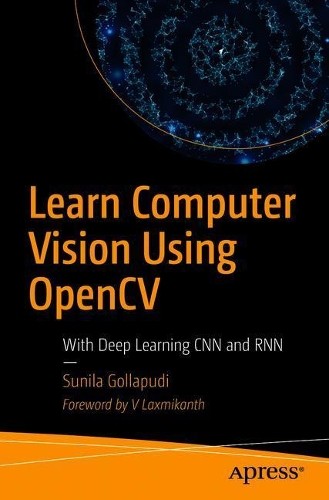
Master Computer Vision with OpenCV, Deep Learning CNNs & RNNs by Sunila Gollapudi (2019 Paperback)
$ 40.63
Description
Build practical applications of computer vision using the OpenCV library with Python. This book discusses different facets of computer vision such as image and object detection, tracking and motion analysis and their applications with examples. The author starts with an introduction to computer vision followed by setting up OpenCV from scratch using Python. The next section discusses specialized image processing and segmentation and how images are stored and processed by a computer. This involves pattern recognition and image tagging using the OpenCV library. Next, you'll work with object detection, video storage and interpretation, and human detection using OpenCV. Tracking and motion is also discussed in detail. The book also discusses creating complex deep learning models with CNN and RNN. The author finally concludes with recent applications and trends in computer vision. After reading this book, you will be able to understand and implement computer vision and its applications with OpenCV using Python. You will also be able to create deep learning models with CNN and RNN and understand how these cutting-edge deep learning architectures work. What You Will Learn Understand what computer vision is, and its overall application in intelligent automation systems Discover the deep learning techniques required to build computer vision applications Build complex computer vision applications using the latest techniques in OpenCV, Python, and NumPy Create practical applications and implementations such as face detection and recognition, handwriting recognition, object detection, and tracking and motion analysis Who This Book Is For Those who have a basic understanding of machine learning and Python and are looking to learn computer vision and its applications. Sunila Gollapudi has over 17 years of experience in developing, designing and architecting data-driven solutions with a focus on the banking and financial services sector. She is currently working at Broadridge, India as vice president. She's played various roles as chief architect, big data and AI evangelist, and mentor. She has been a speaker at various conferences and meetups on Java and big data technologies. Her current big data and data science expertise includes Hadoop, Greenplum, MarkLogic, GemFire, ElasticSearch, Apache Spark, Splunk, R, Julia, Python (scikit-learn), Weka, MADlib, Apache Mahout, and advanced analytics techniques such as deep learning, computer vision, reinforcement, and ensemble learning. Chapter 1: Computer Vision and its application Chapter Goal: The goal of this chapter is to have readers understand the landscape of Artificial Intelligence and the role of computer vision in AI applications. An understanding of how computer vision is applied in various domains and its role in building AI systems No of pages 25 Sub -Topics 1. Overview of AI, computer vision and related fields 2. Real-world usecases and domains for computer vision application 3. Introduction to computer vision and its subfields that includes OCR, ICR etc... 4. Deep dive into deep learning techniques applied in computer vision 5. Architecture, operating model and challenges in building computer vision applications Chapter 2: Introduction to OpenCV and python Chapter Goal: This chapter provides step-by-step instructions to setting up OpenCV with python. Learn core libraries, syntax and interfaces. No of pages: 20 Sub - Topics 1. Install and set-up OpenCV and python 2. Core operations & syntax 3. GUI features 4. OpenCV-Python bindings 5. Build, deploy and debug OpenCV projects 6. Build OpenCV applications for scale by integrating with file systems. 7. Hands-on code using OpenCV libraries Chapter 3: Images: Manipulation & Segmentation Chapter Goal: This chapter focuses on understanding images, how they are stored and processed by a computer. Image Transformations, translations, rotations, scaling, cropping and operations are covered. Segmentation and pattern recognition within images and tagging using OpenCV libraries is covered No of pages: 20 Sub - Topics: 1. Image translations - moving images up, down. left and right 2. Rotations - how to spin your image around and do horizontal flipping 3. Scaling, re-sizing and interpolations - understand how re-sizing affects quality 4. Blurring and sharpening 5. Segmentation and contours - extract defined shapes In your image 6. Blob detection - detect the center of flowers 7. Hands-on code using OpenCV libraries Chapter 4: Object Detection: Chapter Goal: Finding patterns in objects, SIFT, SURF, FAST, BRIEF & ORB - learn the different ways to get image features No of pages: 20 pages Sub - Topics: 1. Objective Detection Overview 2. Videos: reading from Webcam, storing and interpreting 3. Face and eye detection - detect human faces and eyes in any image. face analysis and filtering - identify face outline, lips, eyes even eyebrows. merging faces (face swaps) - combine two faces for fun & sometimes scary results 4. Detecting specific things: landmark, car and pedestrian detection in videos 5. Hands-on code using OpenCV libraries Chapter 5 : Tracking and Motion Analysis Chapter Goal: No of pages: 20 pages Sub - Topics: 1. Learn how to programmatically track a single point over time. 2. Learn how to analyze videos as sequences of individual image frames 3. Motion filed and optical flow 4. Camera models and caliberation 5. Hands-on code using OpenCV libraries Chapter 6: Looking ahead: upcoming applications and trends in Computer Vision Chapter Goal: No of pages: 15 pages Sub - Topics: 1. Upcoming technologies, applications and technologies in computer vision 2. Other open source frameworks landscape both commercial and opensource 3. Intro to advanced computer vision and deep learning techniques



This book is a fantastic guide for anyone looking to dive into computer vision with OpenCV and Python. The author breaks down complex concepts like image processing, object detection, and deep learning CNNs/RNNs into easy-to-follow steps. The practical examples help solidify understanding, making it great for beginners and intermediate learners. The setup instructions are clear, and the real-world applications make the content engaging. Highly recommended for building hands-on skills in computer vision!